Happy 2024! I’m so excited you’re here with me. Coming this February, I will have had this blog for two years! It’s been an interesting journey coming this far. You’ve been here with me through almost half of my secondary education, heartbreak, depression, and four publications! I’m excited for what this new year holds for me, my friends, my family, and my writing. Today, I want to talk about my writing plans.
I know what you’re probably thinking: Not another author talking about their yearly writing goals. Well, you’re in luck. I’m not going to be talking about my goals, but my writing process. I think it’s about time to share some neat writing tricks I’ve been learning. Actually, did you know I’ve been experimenting with my writing process?

I’ve been telling stories for as long as I can remember, literally! I have a few faded memories of my time as a toddler, and many of them include stories I made up. I have a strong imagination that has stuck with me my whole life. Over the last five years, I’ve dedicated myself to experimentation. This year, I feel it’s time to bring together everything I’ve learned about myself and conduct a new major experiment.
After I get A Week in Galerod to your ebook reading device, I’m diving head first into a new novel that only a handful of people know about. It’s something completely new that is unrelated to any of my other projects and doesn’t have literal years of expectations piled on it. One thing I’ve found helpful in all my experiments is that when I’m trying something new, it usually helps to have a new story to go with it. I’ve also learned that talking about it kind of kills my excitement for the new shiny. So, I’m not going to tell you anything about this new story just yet. Rather, I want to talk about how I plan to write it.
First off, I’m not following a particular structure, at least not consciously. I am a pantser by nature, and a plantser in refinement. I love writing by the seat of my pants, but when I’m dealing with a story that contains a lot of world-building, I want to build that world first. I will daydream about my characters all day, always have, but the world takes some intentional planning. Furthermore, I’ll dream up some key scenes with emotional punches, but how to connect all those points also takes some brainstorming hours.
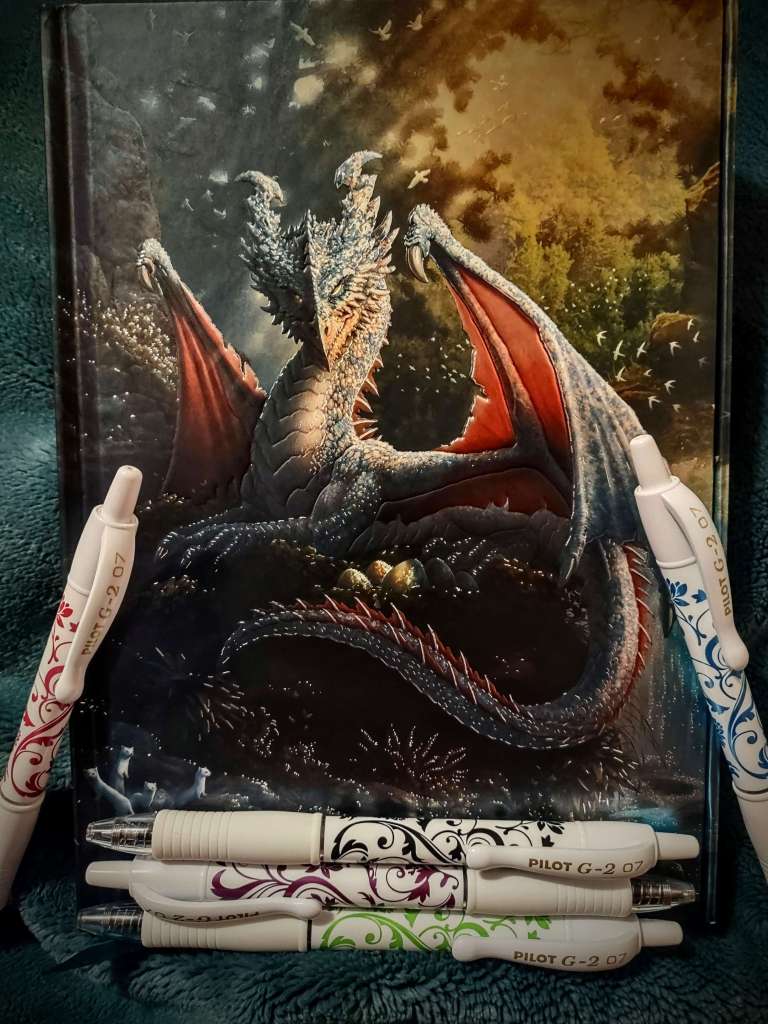
For this stage, I’m using a notebook, whiteboard, index cards, and Discord. Having all my notes on the computer just doesn’t work well for my brain; it’s too rigid of a tool for my chaos. The notebook is where I can keep my final decisions about plot points, world-building details, character bios, etc. The index cards will be used to generate scenes and can easily be rearranged to perfect the novel’s timeline. Meanwhile, my whiteboard is for making random diagrams that I can quickly and easily manipulate with dry-erase markers. Any final product I need to save I just snap a picture of with my phone, which can then be uploaded to Scrivener or Discord.
I use my private Discord server for messier brainstorming sessions and random bits of dialogue. My brain often thinks faster than I can write by hand, and typing out my thoughts like I’m talking to someone helps me really think about what I need for my stories. I like using Discord for this because I can access it from any device, pin messages for easy access, use emojis and gifs, send it to other people, etc. I also use it when my hand can’t hold a pen or I don’t have access to paper. Stuff I put in Discord, once I get it sorted out, will eventually go in the notebook or index cards.
Another thing I learned about myself is I can’t plan every detail and eventuality. I can figure out the big picture in the planning phase, but there will always be nuances I fail to see until I start drafting. I’m super excited about the drafting stage. Back in 2022, I tested the 4 Notebooks Method. It gave me enough direction to keep my story on point, but most importantly, it showed me how much I prefer writing by hand.

By the end of a few months, I had a complete manuscript, and a year later, I transcribed it to Scrivener. My biggest mistake, however, was refusing to edit any part of the story while transferring to the computer. By the time I got all the words typed out, I didn’t remember where anything was or what I wanted to do to edit my manuscript. Sure, I left notes along the way, but not enough, and what comments I did leave weren’t helpful.
A friend in my writing group a few months later said she discovered she does better editing while writing, and I realized I probably would too. I hate editing. I’ve never liked it. When I reach the editing stage, I just stop. But, when thinking about how I could draft some words, then edit them the next day, and draft more, I realized that I could balance my cortisol and dopamine levels. I can get some nasty editing out of the way and reward myself with more drafting after.
So, I have the planning phase out of the way, I know I need to edit during the drafting phase, but what are my plans for the drafting phase? I watched this video a couple of months ago by Jed Herne who attempted to use the same writing process as Neil Gaiman for a week. The way this process worked was the author must sit with a pen, paper, and a window. Nothing else. No music, internet, cell phone, anything that could cause distraction. Mr. Herne found this method worked well to help him get back into a novel he was stuck on.
I already know I do better on paper, but not having any distractions or music around is something I haven’t tried. Additionally, Mr. Herne said that a rule Gaiman put on himself was that during his writing session, if he wasn’t writing, he only allowed himself to stare out the window. This forced him to be bored, thus generating more creativity. My next question was, how do I decide when my writing session is over?
This past November, during NaNoWriMo, I would write until I couldn’t anymore, either due to my hands being tired or my brain going kaput. While it’s fun to be able to say I wrote 50k words in 30 days, it’s not fun coming in each of those days with less and less energy. At the end of NaNoWriMo, I watched a video with R.L. Stine, the author of Goosebumps. He said that he plays a game with himself when he writes: he stops when he’s written exactly one thousand words for the day. The next day, he will write exactly one thousand again.
I thought that was brilliant. I’d always heard about stopping your writing session in the middle of a sentence to help kickstart your creativity the next day, but I never could decide which sentence to stop on. Writing an exact word count, whether that’s one thousand, fifteen hundred, or eight hundred, sounds like the perfect way to do that. My next issue was, however, how do I know when I’ve hit that exact word count? I’ll be writing on paper! Bring in a clicker!

I’ve been wanting a clicker for a while. Sometimes it would be nice to have something that helps me count things. This writing experiment was the perfect excuse to get one. I’ve already been trying it out. I hit the clicker each time I write a word until I reach my desired word count, and then I’ll stop for the day. It’s so much fun, more so than I imagined! It’s not as loud as one might think, and the clicker gives a bit of resistance when it reaches a new hundreds or thousands mark, giving me a warning that I’m approaching the day’s quota.
And that’s it! That’s my new plan. I’m plotting and world-building right now. By February, I hope to start drafting. I’ll be armed with nothing but my pen, paper, and clicker. The day after my first session, I will start with transcribing the previous day’s quota into Scrivener, and editing as I type. Then I’ll draft a new quota and repeat the next day. I’ll edit larger sections as they come, and allow myself to edit anywhere anytime. This way, everything is always fresh in my memory and any changes that occur will immediately get resolved earlier in the manuscript.
Each of these editing stages I’m calling half drafts. I’ve found that calling my paper manuscript “draft 1” and my first round of edits “draft 2” and so on intimidates me. It kind of tricks my brain into thinking that the draft is done and therefore cannot be changed. But, calling my first round of edits “draft 1.5”, the next round “draft 2”, and the next “draft 2.5” feels more fluid, allowing me to think there is still more that can be done. It’s silly how I have to play mind games with myself, but hey, whatever works!

Why am I telling you this? To inspire you to take chances, make mistakes, and get messy. I hate making mistakes, and messiness is the worst, but that’s what you have to do to succeed sometimes. Also, I want you to see that it’s okay to mix things up. I’m taking bits and pieces from several writing methods and combining them into my own personalized plan. These are just the processes I’ve kept. I’ve tried several methods, like the 3 Act story structure, typing everything, typing and handwriting, the Snowflake Method, no planning, all planning, and others.
All of those things did not work for me, and I have a lot of half-finished stories because of it. If this new method helps me get a completed manuscript that I love online for sale in less than two years, then I can go back to those other stories and finish them as well. If this new experiment fails, I’ll evaluate it and see what I can change for the next attempt.
I want to be a successful author. I’ve had to decide for myself what that means, and for me, it means having a published novel once a year and at least ten loyal readers. Really, any amount of readers would be wonderful, but ten… I’ll feel like a writing queen! It all starts with accepting some failure, dusting myself off, and trying again. And if I can do it, I know you can too. Here’s to 2024.
~ Beth

 Beth Freemont